Release design · Editorial note
Astro Bot and the language of playful level design
How can a new release make playfulness feel present in the shape of its spaces, not only in its subject matter?
Mara Ellison · Mara Ellison
Published
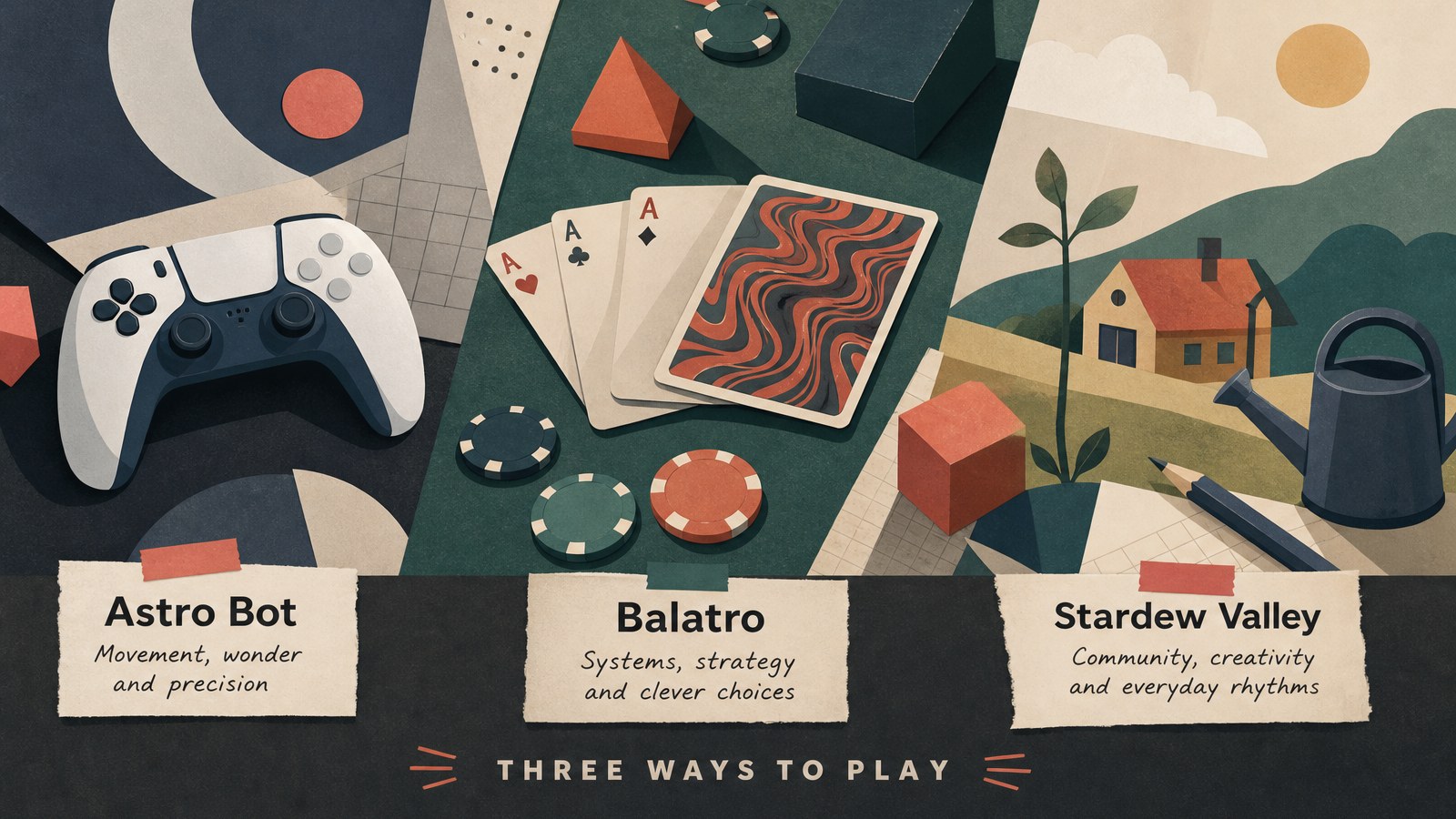
Astro Bot is a 2024 platform game developed by Team Asobi and published by Sony Interactive Entertainment. Released for PlayStation 5 in 2024, it continues the Astro character’s platforming series context established by Team Asobi.
This note looks at how the release communicates playfulness through level design and presentation. It is an editorial reading, not a score or a claim to speak for every player. The more useful question is not simply whether a space looks cheerful, but how it invites attention, movement and response.
Playfulness is built into the route
Platforming levels are read with the body as much as the eye. A player spots a surface, a gap, a change in height or a possible next step, then tests the idea through movement. When the presentation makes those possibilities easy to notice, the environment can feel like an invitation rather than a diagram.
In Astro Bot, the character and the surrounding spaces speak the same expressive language. The platforming context gives the release a clear vocabulary of arrival, jumping, landing and discovery. Our reading is that this vocabulary lets visual detail do practical work: colour and shape can make a route legible while giving it a playful character.
Presentation gives actions a tone
A platform game’s presentation does more than decorate its levels; it frames what an action means. A jump might read as careful progress, a small surprise or a moment of comic timing, depending on the surrounding space and how the release presents the result.
That distinction matters in a new release because first impressions often grow from small exchanges between player and environment. A clear visual cue can make a discovery feel built into the design, while a change in rhythm can encourage the player to pause and look again. These are interpretive observations, but they help explain why level design and presentation are hard to separate when discussing playfulness.
A release that teaches its tone
Astro Bot’s place in Team Asobi’s platforming series context gives readers a release history to consider, but the immediate experience still depends on how each space communicates its expectations. The level is not only a container for actions; it is a sequence of signals about how to approach the next moment.
This is where accessibility and expression can meet. A readable route need not be plain, and lively presentation need not obscure the next action. When the two work together, the player can spend less effort working out what a space permits and more time noticing how it responds to their choices.
Why this angle is useful
Talking about Astro Bot through level design gives us a more precise way to discuss its character than calling it simply cheerful or colourful. It directs attention to the relationship between movement, visual information and the feeling of discovery. It also leaves room for different kinds of participation: a reader may be interested in route-finding, presentation, platforming tradition or the way a new release establishes its tone.
The broader lesson is modest but useful. Playfulness can be a property of structure as well as style. By looking at how a release arranges spaces and presents actions, we can describe what it is doing without turning interpretation into a universal verdict.
Mara Ellison
Pixel Play Journal publishes editorial writing about new releases, player communities and contemporary play culture. Mara Ellison.