Editorial note · Shared discovery
Balatro, rules literacy and the pleasure of shared discovery
How a poker-inspired system makes learning, comparing and explaining part of the pleasure.
By Mara Ellison
Published
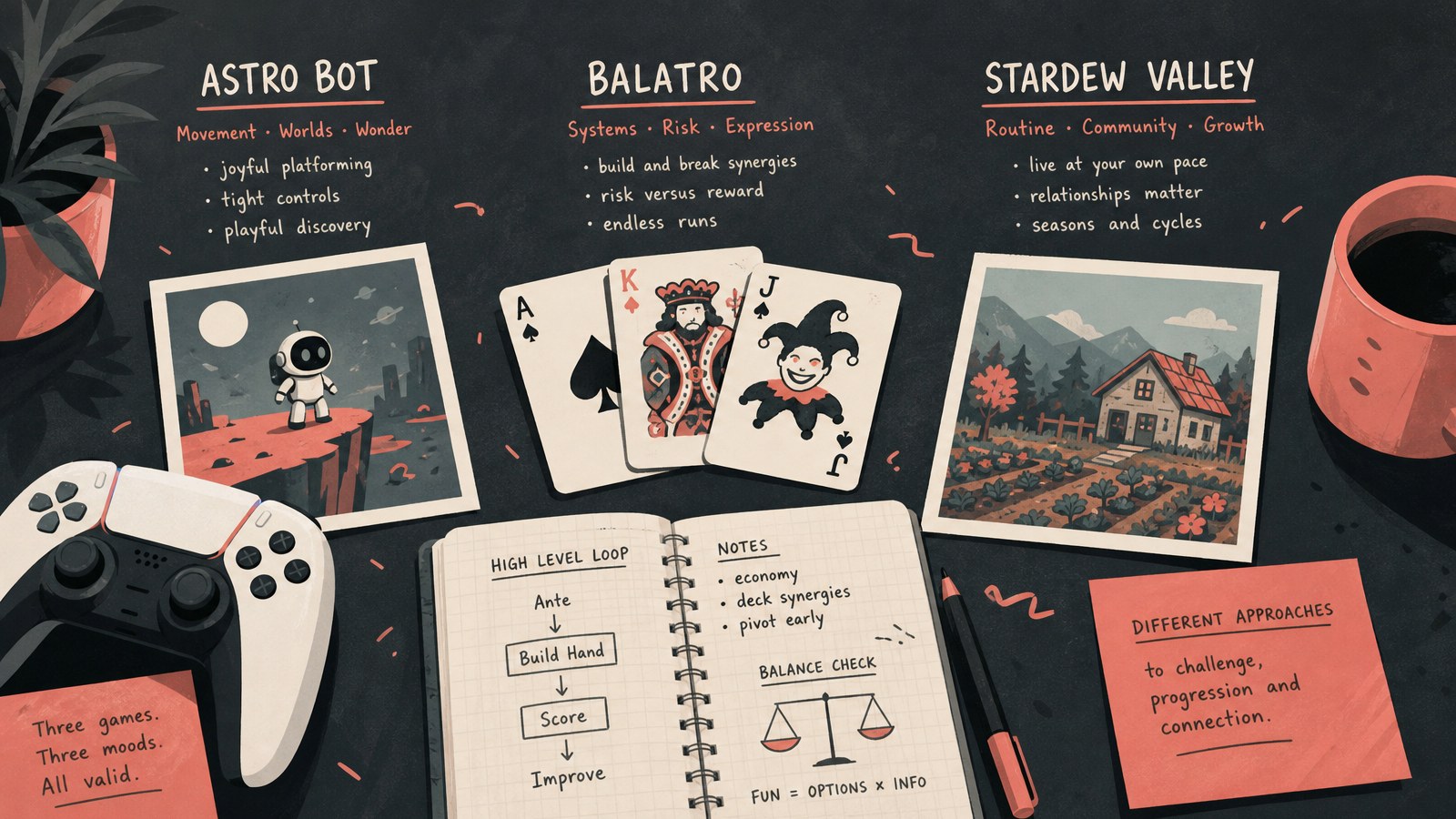
What happens when understanding a game becomes part of the conversation around it? Balatro offers a clear way into that question. Created by LocalThunk and published by Playstack, the 2024 poker-inspired roguelike deck-building game centres its play on combinations, score-building and repeated runs.
Together, these elements bring its rules into view. A run is not only a sequence of decisions; it is also a chance to notice how one decision changes the meaning of the next. Players can describe a combination, test a possibility and return with a clearer account of what happened. The language of play grows alongside the play itself.
Learning is part of the experience
In many games, learning is a threshold to cross before the more expressive parts begin. Balatro keeps that threshold in view. Poker-inspired combinations provide a familiar starting point, while deck-building and repeated runs add room for variation. The result is a system that asks players to move between recognition and interpretation: a hand can be understood on its face, then reconsidered as part of a longer plan.
That is where rules literacy matters. It does not mean memorising every possibility. It means becoming comfortable with the relationships between choices, scores and future opportunities. A player might ask which combination is immediately useful, which choice supports a later run, or how a change in the deck alters the value of a familiar hand. These questions are practical, but they also build a shared vocabulary.
How explanations travel
Repeated runs give discovery a shape that is easy to discuss. A surprising result can be revisited rather than dismissed, because another attempt may reveal a different connection. One player’s explanation can give another player a way to frame their own experiment. The conversation does not need a single correct route to be useful; it can clarify the system by placing several routes beside one another.
This makes comparison more open. Instead of treating a run as a private performance, players can discuss what they noticed: the appeal of a particular combination, the tension between a safe score and a risky possibility, or the pleasure of seeing a plan take form. Describing these choices does not claim to represent every player. It shows how a system can invite people to teach, question and refine one another’s understanding.
A release with room for interpretation
Balatro’s 2024 release context matters because it places this rule-focused experience within a wider conversation about what a new release can offer. Its interest is not exhausted by a first explanation of the mechanics. The repeated-run structure leaves room for players to develop their own ways of noticing patterns and describing what makes a choice satisfying.
Our editorial reading is that Balatro makes shared discovery unusually legible. The game’s combinations and score-building invite close attention, while the repeated runs provide a reason to return to an unfinished idea. That combination turns rules into more than instructions: they become material for memory, discussion and interpretation.
For readers comparing different kinds of play, this offers a useful distinction. Some releases communicate through immediate presentation; Balatro communicates through the gradual pleasure of making relationships clearer. Conversation around it can begin with a simple question-how did that work?-and continue through the patient work of finding language for the answer.
Pixel Play Journal publishes editorial writing about new releases, player communities and contemporary play culture.