Pixel Play Journal is a Manchester editorial publication about new releases, player communities and contemporary play culture. We look closely at what a release offers, then ask how people gather around it, interpret it and remember it.

Read games in context

Our play-culture coverage can also look at how gaming language travels into game offers, including a welcome bonus or vip welcome bonus, without treating promotional copy as a universal claim about play.

Thoughtful notes on new releases and the people who play them.

Compare the approaches

Three ways a game draws us in

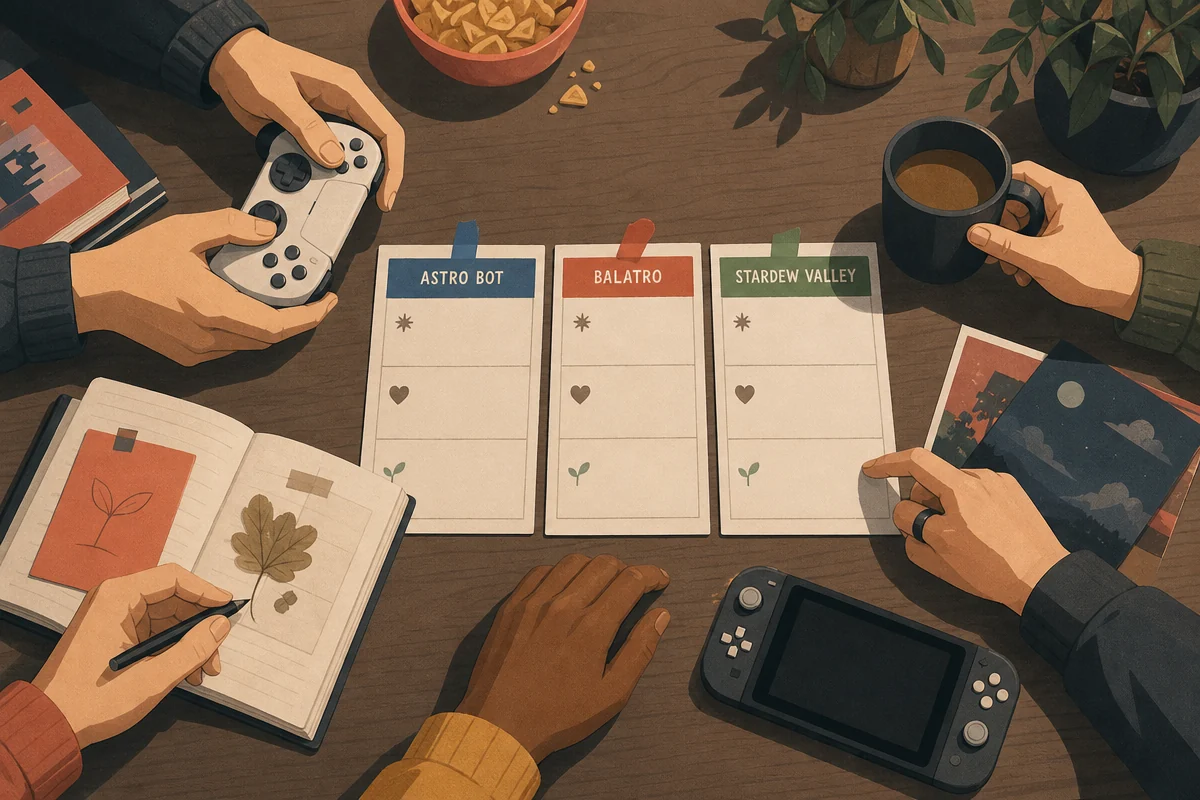
Astro Bot, Balatro and Stardew Valley offer three distinct editorial starting points. Set side by side, they help us compare immediate spectacle, rule-based discovery and the slower work of shared routine without turning difference into a ranking.

Stardew Valley: routine as shared language

Stardew Valley, created by ConcernedApe, combines farming, exploration, relationships and seasonal routines. That range makes it useful for considering how a release can support different kinds of participation and a community's long-term memory.

Balatro: learning through the rules

Balatro is a 2024 poker-inspired roguelike deck-building game created by LocalThunk and published by Playstack. Its poker-inspired combinations, score-building and repeated runs offer a route into the conversations that form as players learn a system together.

Astro Bot: playfulness in the level

Astro Bot is a 2024 platform game developed by Team Asobi and published by Sony Interactive Entertainment. Our comparison follows how level design and presentation communicate playfulness, making release design the place to begin.

Questions to ask before comparing

A useful comparison starts with the subject rather than a sweeping verdict. Pixel Play Journal's reader-questions approach keeps discussion grounded in what a release does, how participation works and what the available context can support.

Name the practice, not the whole community

When discussing a new release, begin with a concrete observation: the way Astro Bot uses level design and presentation, the way Balatro makes rules literacy visible through combinations and repeated runs, or the way Stardew Valley supports farming, exploration, relationships and seasonal routines. Then describe the participation being observed without presenting it as the experience of every player. This is the difference between a useful community note and an overgeneralisation.

Browse the reading routes

Find your way into the archive

Choose by the question you want to carry into the archive: a first impression, a system to learn or a routine worth revisiting.

Balatro: learn the language of the rules

Choose this note if you want to follow how a rule system becomes a shared vocabulary. It is a starting point for readers who prefer experiments, patterns and conversation.

Stardew Valley: stay with the routine

Choose this note if you want to stay with the long view. It gives readers a route into questions about return visits, shared memory and the rhythms that keep a game present.

Astro Bot: follow the shape of play

Choose this note if you want to watch movement and presentation work together. It is the quickest route into the archive for readers who notice spaces before conclusions.

How Stardew Valley builds a shared vocabulary

A release can stay present through the small things people remember together. Stardew Valley offers a useful case study: seasonal routines, practical knowledge and different forms of participation give its community more than one way to keep talking.

Routine becomes something to pass on

Stardew Valley combines farming, exploration, relationships and seasonal routines. Over time, those strands can give players a shared vocabulary for discussing what to do, what to notice and how a particular season felt. Pixel Play Journal's play-history note follows that longer pattern without treating one form of participation as the standard.

Read the Stardew Valley note

A publication team with a clear point of view

Pixel Play Journal presents its work as a publication team rather than a named individual author persona. That keeps attention on the subject: new releases, player communities and contemporary play culture.

Editorial author portrait

Editorial work that stays close to the subject

The Pixel Play Journal team connects release design with the ways players gather, interpret, recommend and remember games. Its writing brings established details and editorial interpretation together without claiming to speak for every player community.

Author

Stay in touch

Bring your question to Pixel Play Journal

Pixel Play Journal welcomes reader questions, responses to its articles and observations about player communities. Share the detail you would like to see considered, and keep the focus on a specific release, practice or piece of context.

Email

Send a reader note

[email protected]

Share a question, an article response or a note from your own play.

Phone

Speak with the team

+44 161 200 1500

Call when your idea is easier to explain out loud.

Visit

Find us in Manchester

2 Tony Wilson Place
Manchester, England M15 4FN

A home for thoughtful notes about games and communities.

Keep it specific. The best notes give us a release, practice or piece of context to think about together.